Sunday, July 29, 2012

The News For Parrots ~ Caliban Consequi

from Tales and Legends of the Isle of Wight, 1839


A LEGEND OF BLACK GANG CHYNE.

The dwellers in Wight they once did wail,
When they lived in dread of the giant of Chale.
The giant of Chale was mighty and big;
And he loved man's flesh better than pig.
He chose those that were tall and heavy,
And stew'd the fat ones in their own gravy.
The children he tied with bonds of wire,
And broiled them alive on a charcoal fire.
He dyed his hands with man's blood red;
He laughed and shook his sides, and said,
"I care not for saint in his lonely cell—
I care not for book, and I care not for bell—
I care not for heaven, I care not for hell—
I live upon man's flesh, and fat me well."

The saint was praying on his knee
For those that are dead, and those that be;
And as he raised his voice in prayer,
He heard the curses fly through the air.
The holy man was struck with dread,
And every hair stood up on his head.
For he knew the time was a fated hour,
When the spirits of earth and sea have power,
And that which is holy quakes and quails,
For the time of the spirit of sin prevails.
The fiendish laughter thrilled through his bones;
And he answered the sound of mirth with groans.
He hailed the voice as it came on the wind,
"What is thy title, what is thy kind?
Who is it scoffs at saint and cell?
Who cares not for book, and cares not for bell?
Who cares not for heaven, and cares not for hell?
But lives upon man's flesh and fats him well?"

The burly giant rose from his lair
When he heard the questions ring through the air.
Then he poured a goblet filled with blood,
And he dipped his hands in the gory flood;
He made a sign with his bloody hand,
And drew the figure in the sand.
"I'll make his spirit quake and quail
That questioneth the ogre of Chale.
I dare him to meet me at midnight dread,
When the horned moon is over our head;
For then the lower spirits and upper,
And those of the earth, I've asked to supper;
Then the imps that ride on the desolate wind
Shall chant him in thunder my title and kind."

There was heard, when the blood of the sign had dried,
A whizzing sound on every side;
It sang in the Culver's goblin cave—
It sang at the Needles and over the wave—
It sang on Hecla's frozen strand—
It sang on the desert's burning sand—
It sang the mountains and clouds aboon—
And the whizzing sound went up to the moon.
The sound went down to the ocean's deep,
And the kelpies were roused from their evening sleep.
And though the night was clear and still,
The wind seemed to whistle round Katherine's hill;
But the sound came not in the chapel fair,
Because the sign of the cross was there.
The bloody sign was a sign of might
To every being that shuns the light;
Whether made by sprite or child of clay,
The bloody signal they must obey.

The holy man was struck with fear
When the words of the giant rang in his ear;
For the giant was mighty in wizard power,
And Hallowe'en was a dreadful hour.
But the fearfullest time was the midnight dread,
When the horned moon is over one's head.
The saint had been dared to come that night,
Or acknowledge his fear of the giant sprite.
He took him a staff of the mountain ash,
His pilgrim scrip and calabash;
Nor spirit did he hold in scorn
Distilled from the barley-corn,
(For he had grown infirm and old,)
To keep himself from catching cold.
At midnight he left his lonely cell
To seek the giant's flowery dell.
In a lovely vale, all down by the sea,
Was the cave of the giant's cruelty.
The valley side was blooming fair,
For every flower blossomed there:
The violet and primrose gay,
And cowslip tall, adorned the way;
Nodded to him the blue harebell,
And smiled the yellow daffodil;
The heath its little eye did twinkle,
And stared the humble periwinkle,
Snapdragon opened its yellow mouth,
Sunflower turned his face from the south—
The blown rose smiled in matron pride
At the little rosebuds round by her side,
Besprinkled with dewdrops all around,
Like a diamond necklace down to the ground;
The foxglove showed its sunburnt face,
And bent and bowed with vulgar grace,
Fluttered a leaf to the moonbeam wan,
Just as a lady flutters her fan;
And every daisy on the hill,
With its yellow face and clean white frill,
Seemed each to giggle and shake its head
As though, if it could, it would have said,
'Twas a comical time and a comical place
To look the giant of Chale in the face.
But though the bank was blooming fair
The robin redbreast dwelt not there;
For the robin was a friend of man,
And would not eat from an ogre's hand.
Though all things seemed to laugh and jeer,
They could not put the saint in fear;
For he had dared both death and chains,
And a noble spirit ran in his veins.


Sudden there crashed a clap of thunder,
Which filled the saint with awe and wonder;
And just before his footpath way
A cavern yawned in the mountain clay.
The cavern it was not paved with stones,
But strewed around with dead men's bones.
On a throne of skulls the giant sat,
And his lamps were fed with dead men's fat.
The sea was studded with goblin sails,
And snakes and adders danced on their tails.
The bats fly high, the bats fly low;
The owlets hoot, and the ravens crow;
The dragons they rattle their scaly wings;
The scorpions show their poison stings.
For the spirits appeared in every shape—
One took the form of a long-legged ape,
And one was like a large black cat;
And one like a boar, and one like a rat;
One grinned in the form of a dusky bear,
Another was like a spotted hare;
Another was like a bloated toad,
That spat his venom on the road.
They laughed, and they grinned, and they jeered to see
The saint come to join their revelry.
The owlet he hooted his laugh in the air,
And in laughter growled the dusky bear.
'Twas a horrible thing to hear and see
These beasts, how they mimicked humanity.

On a table, in lieu of a loaf of bread,
Was a bodiless but living head;
Its sightless eyeballs it rolled about,
And its bloodless tongue it lolled out.
The giant has called for his favourite dish
Of reptiles alive, and loathsome fish.
The soup it was brought in earthenware pails—
The mermen who carried them hopped on their tails;
The leeches crept in and the leeches crept out,
The blind worms and lizzards wriggled about.
As the demons raised their cups on high,
There arose a shout, a yell, a cry—
"Here's a curse on the living, a curse on the dead!
But here's a health to the head—the head.
Old man, there's afire of charcoal and peat:
Do you wish to be roasted? or will you eat?
Here's a boiling lake—you stand on the brink—
Do you wish to be stewed down? or will you drink?"

The saint he was filled with such dismay,
He could not speak, and he could not pray.
The carrion vulture was over his head,
And under his feet were the bones of the dead;
And human skeletons round were lain,
And one of them turned, as it were, in pain.
But when the sign of the cross he made,
His courage came ; he spoke, and said—
"I bless the living, I bless the dead;
A curse upon thee! and I curse the head.
I curse the hill, and I curse the strand—
I curse the ground whereon I stand.
Nor flowers nor fruit this earth shall bear;
But all shall be dark, and waste, and bare!
Nor shall the ground give footing dry
To beasts that walk, or birds that fly;
But a poisonous stream shall run to the sea,
Bitter to taste, and bloody to see;
And the earth it shall crumble and crumble away,
And crumble on till the judgment day."

He spoke, and a mist came over his eye—
He saw not the land, and he saw not the sky.
But when the mist had rolled away,
The earth looked black, and the rocks looked gray;
At his feet there flowed a blood-stained rill,
And bleak and lonely stood the hill.


Friday, July 13, 2012

Swagger and the Much-Abused "Lotuseaters" of Club-Land

THE DECLINE OF SWAGGER
from London Spectator
via Science, Vol. 19, Feb 25, 1892

We shall not, we hope, be accused of knocking another nail into the coffin of Respectability if we venture to point to the decline of swagger as one of the signs of the times. No doubt the change is somewhat recent, and the transition hardly complete. But we may take it as established that, for the moment at any rate, swagger is not the fashion. No doubt the consciousness of personal merit and possible superiority is as strong in human nature as ever. But most people are contented to acquiesce in the knowledge of the fact, and are willing not only to forego the particular form of its expression which is known as "'swagger," but even to live without expressing it visibly at all. The most obvious and disagreeable form of self assertion, which consists in making other people conscious of their inferiority by intensely unpleasant and supercilious behavior, has, of course, been dead and done with as a social claim for half a generation. Highborn and wealthy heroes of the old novelists, who were too great to speak at the breakfast-table, and "turned to fling a morsel to their dogs with an air of high-bred nonchalance," exist no longer in fiction, and very rarely in life. Mr. Grandcourt was perhaps the last of them. But swagger in its minor and more amusing manifestations is also dying; and though it is premature to write its epitaph, we may call attention to some of the symptoms of its decay. One of the later forms of swagger, much affected by men of the bachelor leisured class, and especially by the much-abused "lotuseaters" of club-land, was the nil admirari attitude. It had quite a vogue for a time, and in addition to conveying an impression of superiority, saved a great deal of trouble. Older men who had seen life were spared the effort of hearing about it again; and young men who had not were able to convey the impression that they had. This form of swagger had positive merits in a negative form. It is still in use as a weapon against a bore, but as a fashionable cult it exists no longer. It is as dead as wigs and powder.

Soldiers, for instance, are now among the quietest of men, not marked off by any mannerisms of dress or demeanor from other well-bred and agreeable gentlemen. No doubt "competition," in place of purchase, has somewhat reduced the number of men of private fortune who hold her Majesty's commission. But even if that consideration could account for the difference, the change is only partial, and the cavalry is still a service mainly officered by men of means. But the heavy "plunger" swagger which once distinguished these gentlemen in their relations to men in less fashionable professions has almost disappeared, except among a few of the very old stagers who cannot unlearn, and the very young ones who have not learned better. Some evidence of the change of manner among soldiers may be found in their increased popularity in general society—among men, that is; for it may be doubted whether the other sex quite shares the satisfaction with which men hail the absence of the military swagger. Sir Thomas de Boots no longer comes in "scowling round the room according to his fashion, and a face which is kind enough to assume an expression which seems to ask, 'And who the devil are you, sir?' as clearly as if the General had himself given utterance to the words." On the contrary, he as a rule makes himself exceedingly pleasant, claims no more attention than is spontaneously rendered to him and his known position in the service, and perhaps forgets to fill his glass while engaged in explaining the theory of the Kriegspiel to some inquiring youngster.

Among minor types we may notice that the scholastic swaggerer whom Thackeray denounced among his university snobs has almost, if not quite, disappeared — partly, perhaps, because scholars are now turned out by the hundred instead of by half-dozens, and their monopoly of a certain kind of knowledge is broken; partly because good taste has grown with knowledge, and scholars may also be men of the world. No doubt, with wisdom cometh understanding; but we wish that those men of the age, the "scientific gentlemen" — scholars are rather down in the world just now — could discern the signs of the times in the matter of swagger. At present they possess, with Jews, mushroom financiers, and very successful tradesmen — the Egerton Bompuses of the day — almost a monopoly of the amount of obvious and positive swagger visible. Whether in public controversy or social intercourse, the scientific person sometimes swaggers with unquenchable energy. In those public discussions which lend such piquancy to the columns of the Times in the dull season, he still delights to pounce from his hygienic mountain home on some wretched disputant, and show him up as an ass — and a fraudulent ass — in that strong native Saxon, undimmed by "pedantry" and "silly compliance," which less gifted minds call education and courtesy. And if some weak controversialist writes in the victim's defence to say that, after all, what was in the poor man's mind was perhaps so-and-so, how promptly some other scientific person takes up the cudgels and knocks the nonsense out of him! These sterling qualities have so endeared him to the social circle that the mere reference to a "professor" — an honorable title which seems to be monopolized by the expounders of natural science — is usually enough to drive any number of plain men half frantic. No doubt society has itself to blame in a measure for the tyranny of the professors. It overestimated the value of the "facts" which they knew, before they could be weighed and compared with other forms of information. The modesty of Faraday, with his mild formula, "It may be so," and of Darwin — who was a country squire as well as a biologist —are forgotten in the swagger of the new men. But swagger, though not confined to parvenus, is, after all, the parvenu's besetting temptation; and the "scientific men" are the parvenus of knowledge.

Swagger, nowadays, is mainly limited to people living in little worlds of their own. Contact with the big world and realities rubs it away. Petty country squires, buried in remote neighborhoods, often give themselves airs most comical to behold by those capable of comparing what they are with what they claim to be. The bumptious scientific gentlemen who have made their class a byword, the bloated financier, and the overgrown shop-keeper, even when success is attained, are only on the verge of the world where their training should begin. Their time has been otherwise, and, let us hope, more profitably, occupied; and if they do not reform, their children probably will, and will do their best to reclaim their erring parents. For there is no lesson which that increasingly wise young person, the young man on his promotion, has laid more to heart than that "swagger," or, as he prefers to call it, "side," does not pay; and whatever his private opinion as to his own merits, he distinguishes very clearly between the swagger which does not pay and judicious self-advertisement which does. Moreover, being an educated young person with some claims to good taste, he is discriminating even in the means he takes to advertise himself, having recourse only as a last and doubtful resource to self-assertion or eccentricities of dress and manner.


Tuesday, April 17, 2012

The News For Parrots ~ Of Mulligrubs and A Drop Too Much

from Bombastes Furioso: A Burlesque Tragic Opera in One Act, 1817

Enter Fusbos, and kneels to the King. 

Fus. Hail, Artaxominous! ycleped the Great!
I come, an humble pillar of thy state,
Pregnant with news— but ere that news I tell,
First let me hope your Majesty is well.

Art. Rise, learned Fusbos! rise, my friend, and know
We are but middling—that is, but so so.

Fus. Only so so / О monstrous, doleful thing!
Is it the mulligrubs a Heels the king?
Or, dropping poisons in the cup of joy,
Do the blue devils your repose annoy?

Art. Nor mulligrubs, nor devils blue, are here,
But yet we feel ourself a little queer.

Fus. Yes, I perceive it in that vacant eye,
The vest unbutton'd, and the wig awry;
Ungarter'd hose, with slippers down at heel,
And beard unconscious of the biting steel:
So sickly cats neglect their fur-attire,
... And sit and mope beside the kitchen fire.

Art. Last night, when undisturb'd by state affairs,
Moist'ning our clay, and puffing off our cares,
Oft the replenish'd goblet did we drain,
And drank and smok'd, and smok'd and drank again;
Such was the case, our very actions such,
Until at length we got a drop too much.

~~~~~~~~~~~~~~~~~~~~~~~~~~~~


The News For Parrots ~ Black Velvet Painting Already Passe In 1833

VELVET PAINTING

Velvet painting was a few years ago a very fashionable study for young ladies; because it was thought, as is now thought of theorem painting, that it could be acquired without any knowledge of drawing, or that study and correct taste which watercolors and oil painting require. For this reason, every Miss, however deficient, imagined that she might become an artist, if she could pay the sum of three dollars to some teacher who pretended to teach velvet painting, for that price, in six lessons. Unfortunately, there were always professors of the art who were willing to aid this mistaken idea. Frightful specimens were daily multiplied, and the few who admired and had a perfect knowledge of the art, soon were disgusted with it, and let it drop into oblivion; so that we now scarcely hear it mentioned, or see any traces of it, except when we travel through the country where painting has not made great progress. We may then see the walls covered with awful hieroglyphics; and if we inquire of their import, we are told that they are Moses lying in the bulrushes, Joseph going into Egypt, the Children of the Wood, or a Family Obituary Ground, &c. &c.; and that the young lady who executed them had a great taste for painting, and did the whole in six lessons!
Now the art of painting on velvet, though it has thus ingloriously fallen into disrepute, will, I hope, find hereafter, some votaries, who will come forward to practise on its simple but unavoidable rules, which are no more nor less than those laid down for all other kinds of painting, viz: a knowledge of drawing, a discriminate taste, and time and patience to do it well. With this improvement in view, I shall feel encouraged to give you a few directions for this kind of painting.


Monday, April 9, 2012

The News For Parrots ~ If Cleo Had Only Been Liz


from Types of Pan by Keith Preston, 1919

Onomatomancy

The urge of the midge to the flame,
   Is naught to the lure of a handle;
The mind is a fluttering moth
   And a name is the perilous candle.

I know names that are smoother than silk,
   And names that are softer than butter;
I know names that are perfectly sweet,
   And names that are utterly utter.

If Cleo had only been Liz
   Her beauty would not have distraught me.
If Flo had been Irma her phiz
   Would never, no never, have caught me.

Oh Min! When I hear it I wince!
    Maria may rank as a charmer;
But her monicker makes her a quince:
   A name is the joint in my armor!

~~~~~~~~~~~~~~~~~

Thursday, April 5, 2012

The News For Parrots ~ Mina Loy and Cures for Cosmic Neurosis

archive.org has added The Little Review, Autumn 1921, with an amazing metaphysical tract from Mina Loy.


PSYCHO-DEMOCRACY
a movement to focus human reason
on
THE CONSCIOUS DIRECTION
OF EVOLUTION 


to replace the cataclysmic factor in social evolution WAR. An
absolute, constructive and liberating ideal put to the will of
mankind for acceptance or rejection.

Psycho democracy...

 
...Cosmic Neurosis 
   The destructive element in collective consciousness induced by inhibitive social and religious precepts that ordain that man must suffer and cause to suffer and deny the validity of Man's fundamental desires, has resulted in Cosmic Neurosis, whose major symptom is Fear. 
   This fear takes the form of international suspicion and the resulting national protective-phobias. 
   Our enlightened psychological principles will put an end to Cosmic Neurosis...
~~~~~~~~~~~~~~

Mina Loy is also included with Alfred Kreymborg, Orrick Johns,  Horace Holley, and Mary Carolyn Davies in The Charlie Chaplins of Poetry by Clement Wood in The Independent, Vol. 93, which begins:

Poets are queer beings, in the opinion of more normal souls; but there are degrees of queerness.
~~~~~~~~~~~~~~~~~
And finally, here is a review of her Calfax Gallery show in the Studio Talk column in The International Studio, Vol. 48.

Her origins of two paintings are further described in The Interrupted Conversation, an essay about the influence of reality on creativity in Carl Van Vechten's book The Merry-Go-Round, quoting Dickinson Sitgreaves:

"All artists create only in the image of the things they have seen, reduced to terms of art through their imagination. The paintings of Mina Loy seem to the beholder the strange creations of a vagrant fancy. I remember one picture of hers in which an Indian girl stands poised before an oriental palace, the most fantastic of palaces, it would seem. But the artist explained to me that it was simply the facade of Hagenbeck's menagerie in Hamburg, seen with an imaginative eye. The girl was a model. . . . One day on the beach at the Lido she saw a young man in a bathing suit lying stretched on the sand with his head in the lap of a beautiful woman. Other women surrounded the two. The group immediately suggested a composition to her. She went home and painted. She took the young man's bathing suit off and gave him wings; the women she dressed in lovely floating robes, and she called the picture, l'Amour Dorlote par les Belles Dames." 
~~~~~~~~~~~~
d'Emile Bayard


Tuesday, April 3, 2012

The News For Parrots ~ Traveler Fellows

from Charmian Kittredge London's 1915 book The Log of the Snark.


50 years earlier, the price of Womb Veils is holding steady at $8.00 and one has a choice of hard rubber or glass Eye Sharpeners.  One cannot advise using the Electrical Machine and Magnetic Ointment simultaneously.

The News For Parrots ~ After The Husband Test

I just finished reading The Husband Test, 1921, by Mary Carolyn Davies and followed with this poem from her 1919 collection Youth Riding.

MARRIAGE

Back from the dusty church,
The words all said
And the strange kiss given,
We walked down the long lane of Fourteenth
     Street,
(Our shoulders touching home-bound clerks,
And shoppers, straggly shawls about their
     heads),
To the Hungarian restaurant where for
     weeks
You had courted me between the soup and
     steak.
To-night
The mirrors all about the walls seemed only
To show your face to me, and mine to you;
Wherever I might look, I found your eyes,
You mine, and as we gazed
We quite forgot that earth held other things;
Until our friendly waiter, twinkling-eyed,
Came bustling back, a link from heaven to
     earth.

Three blocks of windy street,
Three flights of stairs,
And then we stood
Before your studio door.
You turned the key
And groping in the dark, you found a candle
And pouring tallow in a little pool
Upon the mantelpiece, you stood it there
In its tall whiteness.

There was rain outside;
The skylight hummed and rattled with its
     coming.
A few faint sounds blew up from the loud
     distance;
The grunt of a Salvation Army's drum
Blent with the noise
Of women's voices roughened by the night
Singing from hearts the night has roughened
     too —
And softened.

The street flung up its sounds against our
     window,
But could not force the fortress of our
     thoughts,
Your thoughts of me, and mine of you, old,
     new,
And riotous —
And frightened —

We, who had always been such open com-
     rades,
Now were half afraid
To touch each other's hands,
To see each other's faces in the dim
And holy dusk.

We thought of God. I prayed to Him,
As I had prayed when first you said, " I love
     you,"
The same quick, breathless, little broken
     prayer,
"God, oh, don't let us hurt each other, ever."

The portraits you had painted were about us,
A ghostly company of friends.
Life seemed all ends;
Ends of things finished, ends of things begun,
Ends, ends —
No safe and placid middles.

Because the silence choked from utterance
All other words, we talked of daily things,
Your order for a cartoon, and the story
Long overdue, that I must mail to-morrow —

And then the silence
Laid its hands even on these commonplaces.

We looked at one another gravely,
Shy children that our mothers, Youth and
     Life,
Had brought to see each other, and to play
Together.

Two startled children
Permitted by the gold ring on my hand
To stay and talk there in the dusk alone
And for the first time not to think of clocks
But if we liked, watch night's dark bud bloom
     dawn.

The silence grew and filled the room's dim
     corners.
The candle on the mantel burned its life out
And its flame died, and all the room was
     dark;
And on the skylight fell the black loud rain;
And in the world there was no other sound
But your breathing
And the beating of my heart.

Then in the dark
You stumbled to me
And caught me by the shoulders
And laid your mouth on mine.
And all the hunger of our lives for life,
And all my hunger for you, yours for me,
Surged up in us, love caught us as a storm
A helpless ship, and beat upon us; joy
Rose like a tossing sea, and swallowed us.

~~~~~~~~~~~~~~~~

Here is a biography, mostly provided by her brother, in The Bookman, Vol. 54.

Fred Lockley writes an account from Oregon, of an Oregonian who has migrated to New York City:
Mary Carolyn Davies, author of "The Husband Test", was born at Sprague, Washington, of Welsh and Danish ancestry. "We come by our Joy of writing naturally," said L. L. Davies, her brother. "My mother was richly endowed with the creative gift and her mother also was a writer. My father was a miner, and for eight years we lived In Casalo, B. C, on Rootenay Lake. Casalo was a unique community, very different from the ordinary American village or small town. While we were there we published a magazine. All of our family wrote for it, as well as other members of the community. It was hand written throughout and the Illustrations were also hand work. We produced each week twelve copies, which circulated throughout the entire community until everyone had read them.
"When my sister Mary was fourteen years old and still had braids down her back she was writing clever verse. While she was in high school she wrote a story and sent it to the 'Youth's Companion'. They sent her a check for forty dollars. This decided her to take up a literary career. To secure the money to go to the University of California she taught school for a year in eastern Oregon, near a little settlement called Post. Each day she rode three or four miles to her school on horseback. Riding has always been the one thing, next to writing, which she most loves. She attended the University of California for two years, majoring in English literature. This was In 1911 and 1912. Here she won the Emily Chamberlain Cook prize and the Bohemian Club prize, both awarded for the best verse produced by a student during the year. During her stay at the University she came under the Influence of Professor Gayley and of Warren Cheney. They encouraged her to make literature her life work. She also became well acquainted with Jack London and his wife Charmlan. Their friendly interest stimulated her greatly, and at their advice she went to New York University. She became a member of the Poetry Society of America, and when she came back to Portland was elected president of the Women's Press Club of Portland.
"In 1918 she published her book of verse entitled 'Drums In Our Street', and in 1919 a one act play entitled 'The Slave with Two Faces'. Her book of child verse, 'A Little Freckled Person', also published in 1919, Is going very well. 'Youth Riding', another of her books, is a collection of her more recent verse. 'The Century', 'Harper's', 'The Atlantic', 'The Cosmopolitan', 'The Bookman' and many other high class magazines have published her work."

Sunday, April 1, 2012

The News For Parrots ~ Moonshine and Wind Music

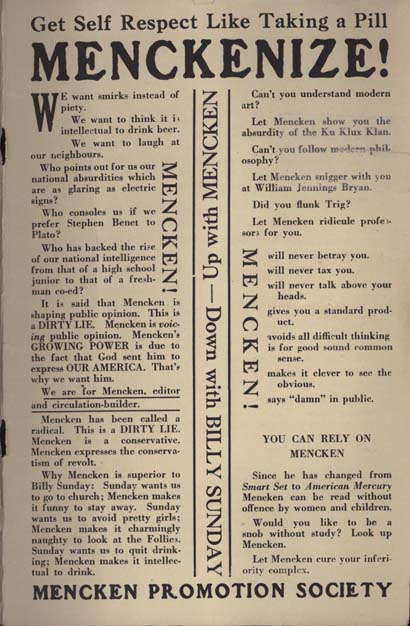
If you want to find out how a philosopher feels when his is engaged in the practice of his profession, go to the nearest zoo and watch a chimpanzee at the wearying and hopeless job of chasing fleas. Both suffer damnably and neither can win...For the absolute, of course, is a mere banshee. No such thing exists. Philosophy in the narrow technical sense is largely moonshine and wind music.

H.L. Mencken from
In The American Jungle: 1925-1936
by Waldo Frank


Saturday, March 17, 2012

The New For Parrots ~ Words Fail

from A Third Of Life by Perriton Maxwell, 1921

from Cosmopolitan, 1906
 

The News For Parrots ~ How Long Can A Queer Artist Fool The Public?

A Dialogue In Black
by Merriam Bliss             from The Black Book Vol 1, 1895

EARLY every night it is the custom of Papa Quotation Mark to take his son little Query Mark on his knee and expound the wonders of the universe and the stern necessity of keeping abreast of the times. It was during one of these harmless seances that the following conversation anent the so-called "new art" took place:

Little Query Mark: "Papa, who is the funny artist that makes black pictures with white spots in them, for the English magazines?"

Mr. Mark "Oh, you mean Aubrey Beardsley, do you not, my son?"

Little Query Mark: "Yes, I guess so. Does he live in an insane asylum, Papa?"

Mr. Mark: "Oh, no my son. He lives in a comfortable flat and has a fat bank account and a fine studio."

Little Query Mark: "Does he really mean to do such queer things or are they accidents?"

Mr. Mark: "He takes himself very seriously my son and so do a lot of other odd people. His pictures are made intentionally queer."

Little Q. M. "But papa, why does he make funny ladies with thick lips and draw them with black spider waists and big feet? Does he see folks in that way?"

Mr. M. "Nay, nay, my son he sees people just as you and I see them."

Little Q. M. "Then why does he draw nightmares in black and white if he knows better."

Mr. M. "Because my son he has found out that people are very gullible and will think a thing is great if it is too silly to have any meaning. Besides it is much more easy to throw a brush filled with ink at a piece of white paper and call it an 'art poster' than to carefully draw
a design that means something."

Little Q. M. "Papa, does anybody really, truly like Mr. Beardsley's work?"

Mr. M. "They pretend to, my son. It's the proper thing to take sides with a popular fad."

Little Q. M. "Is Mr. Beardsley a popular fad, papa?"

Mr. M. "Yes, my son, and so are his-his-his~were you going to ask another question my son?"

Little Q. M. "Yes papa. Does any other artist imitate Mr. Beardsley's stuff?"

Mr. M. "Only a million other artists imitate Mr. Beardsley's work my boy."

Little Q. M. "Is it wrong to copy Mr. Beardsley's style, papa."

Mr. M. "Decidedly wrong my son. It is a crime, and ought to be punishable with death."

Little Q. M. "Why is it a crime to imitate Mr. Beardsley's work papa?"

Mr. M. "Because the crazy things of the wretched copyists drives good artists to drink my child."

Little Q. M. "What sort of art do they call Mr. Beardsley's work papa?"

Mr. M. "They don't call it art my son; they call it rubbish."

Little Q. M. "Can anybody do the kind of work that Mr. Beardsley does papa?"

Mr. M. "Oh, no, my son. Only a very ill or weak minded person who has never learned to draw can do the real thing."

Little Q. M. "Mr. Beardsley and his million imitators will be very rich next year won't they papa."

Mr. M. "Not on your silhouette my son. They will be at the bottom of the tureen of popular contempt."

Little Q. M. "How long can a queer artist fool the public, papa?"

Mr. M. "Until the public takes a tumble to itself, my son."

Little Q. M. "Papa what do the critics say about the Beardsley things?"

Mr. M. "One critic says:

You can bet your bottom dollar
We're on to the Beardsley caper,
A little brush, a pot of ink
And lots of empty paper."

Little Q. M. "Papa when does..."

Mr. M. "It's time to go to bed my son."

Beardsley is the chief apostle of the grotesque. He lives by his affectation and to his posing, personally and in his art, there is no end. A shining example of his verbal posturing was displayed in a recent interview. "In what spirit do you receive the criticisms lavished upon your work?" queried the scribe.  "I suffer my critics gladly," he replied, a touch of hardness coming over his face; "their inconsistencies and futile hypocrisies fill me with amusement. The British public, or rather, those who make their laws in the press or the platform, will forgive anything to a French artist, nothing to his English comrade. Thus they go into raptures over a most brutally realistic, though admirable, work by Lautrec, and hide their faces before more innocent art contributions to the English periodicals. They alone have discovered the Unmentionable. The critic desires to produce not criticism but copy and abuse trips glibly off his pen."

Then came a theatrical pause while this too clever youth eyed the Interviewer to see the effect of his Indirect Insult.

Friday, March 16, 2012

The News For Parrots ~ Always With The Djuna


THE YELLOW JAR

White butterflies are creeping near
    This yellow jar where rose-leaves lie,
Like simple nuns in gowns of fear,
    Like humor and like tragedy.

And down they steal with throbbing wing
    Across the pool of shadows, where
That other bowl of dust is king
    With blossoms past, with tear, with prayer.

One was the rose you brought, and one
   Was you. The symbol lied—it seemed
You were the summit of the sun;
    Now you are less than that you dreamed. 
 
In life we loved you, and in death
   There is devotion for you, too; 
Only the witless human breath
   Is mourning for the death in you.
   
Yet what of you, I wonder, stands
   Without the stillness of the room,
Beyond the reach of rising hands,
    Still smiling at this china tomb!
White butterflies are creeping past
    The jar of death, the yellow jar;
For butterflies are not the last
    To sense things are not as they are!

                                                                              Djuna Barnes 


Tuesday, March 13, 2012

The News For Parrots ~ Djuna Barnes Interviews A Dancer on his Draper

A Philosopher Among Russian Dancers
Bruno's weekly: Volume 2, 1915

An Interview with Adolf Bohm.

THE tumult and the shouting dies, the press-men and the veils depart—and what is left?—Some cosmetic errors, the sound of the stretching of the arch of multitudinous feet and Adolf Bohm.
He it is who has discovered himself next to Najinski, now that Najinski has gone. He is the pampered, over-familiar Le Negre, of the chosing of that top-heavy though attractive high-hipped Zobeide. He, who is Chef guerrier of Le Prince Igor, not forgotten in Les Sylphides and still on view in La Princess Enchantee and Soleil Du Nuit.
He comes through the melieu of the Ballet with the smiles of the man who suffers in three languages.
"Bakst --ah, there you have not only the savage, you have also the artist. I have often thought, how dreadful to be the picture—you know what I mean? No? I shall explain. Notice the eye of the connoisseur of arts, then imagine yourself their goal. See? It is so with the costume. Therefore, I say, how dreadful to be the picture but how still more lamentable to be the costume.
"Bakst is a successful organ; he has a keen appetite, a nose for cafes, a delightful sense of humor, an impressive style of flirting. His advances are of a marked and successful nature, considering his natural inborn plainness. Of his retreats one might say they are masterly. He sails a boat and drinks tea with graceful repugnance.
"He has however one fault—ah, an immense trifle—his head-gear the hoods, the turbans, the what-nots that he conceives for the heads of his disciples—Beautiful? Yes, as only ugly and vulgar things are,—but—"
He paused knocking his gold cigarette case upon his palm 
"But my friend Leon forgets that in the classic arts the feet should have pre-eminence.
"Is Bakst new, is his art the art of the creator? Often I am asked that, very often I hear others asked that. There is an answer. The tragedy of man—there had been a past; the tragedy of nature—there will be a future.
"Without your yesterdays all would be great today. No, of course, Bakst is not new. Egypt may have been builded on the dust of an older Egypt, Rome may have fallen once again on Rome.
"In Russia there are other Russians—better perhaps, and also, perhaps not. Bakst happened to come when he was needed, when the world was ready for him.
"It is harder, I admit, to become known for what one has not done than for what one has. Bakst took the easiest way, he became known for what he did. Not for his restraint, but for his vigor. One can say of him what Wilde said of Hall Cain—he creates at the top of his voice.
"Therefore it is that one should not say Bakst dares, one should say Bakst dares again.
"Some of his designs are purely graphic. From the mind, for the paper. These are the kinds I have reference to, when I say how painful to be the costume. I have had to outrage Bakst, because Bakst has outraged me.
"He invents, say, something he considered decorative, but imagine trying to dance entangled with all the intricacies of Bakst's mind.
"Well, we have made our concessions each to the other" he added.
When I asked him if America could appreciate Russian art he answered:
"You are not asked to understand Russia. You are asked to feel. One does not understand death, one only reacts to it."
I said that the whole production had struck most of us as art under the skin. "A matter," I added, "of gastric acoustics, arteries and undressing or over-dressing," also concluding, "but only of the kind we lament because that savage sharpness, that peasant betterness and vitality given us so richly in the literature of the Russian and in the Russian history, is missing.
"In other words they seem to be economizing on perspiration." I finished.
"He has fallen into the estate of the man who forgets that destruction is more necessary than construction. The rich perversity of a decaying flower is only transcribable in the still richer, still more perverse flare of the decaying art. The happier midways of life and death. The conception that feeds on itself,—that is the most beautiful and the most destructive. Bakst has forgotten, it seems to me, and has instead tried to make something too new, and in consequence has made it too raw. Wounds are all very well but only in that they bleed. Bakst is a wound in which the arteries refuse their waters."
Bohm shook his head "Yes and no, as the peasant says. I admit that he is not always simple. That is what I tried to point out just a few minutes ago. It is his insincerity that sometimes gets in his way, nevertheless his art is a fine thing and the world is coming to know that, and then there will be others.
"Now let me say something that touches America. You want too many doctors. Only people who go around with the assurance given by medicins could expurgate so freely your books and shave down to so fine a point, your arts. When you have ceased to have stomach troubles you will not mind the hard and healthy spleen of the children of L'Apres-Midi d'un Faune."
Djuna Barnes.
Whoever will be free, must make himself free: freedom is no fairy's gift to fall into any man's lap.
Friedrich Nietzsche 
~~~~~~~~~~~~~~~


The News For Parrots ~ Sex Is The Androgyne

 Sex,

From the German of Stanislav Przybyszewsky

By Guido Bruno

IN the beginning there was sex. . . .

 Out of the voice box of the human being sex tore the first long-stretched sounds, it directed them to the tact of the pulsing heart, it formed them into rhythm and melody, it shaped them into the neighing, howling and growling of pain, into the snarling and grinning of hatred, into the murmuring and whispering of love, into the smuttered, heaven-high joyful shouts of gladness of the organism and of ecstasy:

Sex gave birth to the world:

And sex diffused itself with super-power into the muscles of the human body; it handed man the club as it came upon him to destroy his rival in the contest for his mate, it increased his powers unto the indefinite when he had to protect the life of his mate and of his brood. It helped him to clear forests, to tear apart the womb of the earth, to direct into new beds rivers and lakes, to subdue seas and to conquer mountains; sex awakened the brain from its slumber, forcing it into incomprehensible suffering and into the labors of never-heard-of work and into cunning and into the sly betraying with which he stole the fire from the gods and into audacious daring so that he mounted the Pelian upon the Ossa, and so that he broke open the doors of the kingdom of heaven.

Sex gave birth to the deed.

And sex forced its way into the heart of man. If filled it out completely. It awaked in man the desire to see everybody as happy as sex itself was in its sacred elevation of happiness. It incended in him the powerful wish to play music for the whole world to a joy-dance, so that everybody might become self-conscious in blissful play and might join in the great sacred hymn of life. To the tables of richest banquets did it invite all, and therefore sex created pity and consolidation, it created father and mother, brother and sister, it united the human sex through bonds of blood and of friendship. But at the same time it became the origin of revenge fulness and of inordinate desire of murder and of crime; it separated and crushed to every wind the seed of the Abel, of the Seth and of the Cain. . . .

And so created sex the family, the clan, the nation. And then it tore open widely its eyes and looked back with inexpressible longing and looked far, far back towards its divine origin.

Millions and millions of years had it been staring into the sacred fire whose lustre meant life to all worlds and all animals on which it lived.

Sex craved for divinity!

And it expanded the chest of man with fervent longing, it saturated his heart with the sweet poison of weakness and of trust, it stole one beam after another from out of the aboriginal fire until it had incended in the soul of man a heart-flame through which it started to dissolve and to diffuse completely and forgot its own self-subsisting ego.

In the love!

And there came to pass the miracle: Amorphos Hyle united with the Logos!

The Holy Spirit descended upon sex and thus sex created —love.

And now the bars broken down and the doors of the human soul opened wide to the stars, to the heavens, to the sun; the beams of mercy and the most incomprehensible wonders sprouted suddenly from invisible origins; a thousand unknown feelings, comprehensions and perceptions expanded the human soul, expanded it to the bigness of the divine being; the arms were stretched out toward never-thought-of worlds; it bowed the knees before gruesome mysterious powers and man rooted up dust in terror, in trembling and in reverence; hidden forebodings became certainties and the certainty did hide in the deep, unlit darkness of the unknown—the unknown which was so indefinitely near. Mindful of its divine origin, sex nestled in the heart of man with the glad tidings:

Sex was the first one to talk to man of God! The superpower of sex grew with love and the consciousness of its divinity.

A hot stream poured out into the darkest hiding places and the most secret faults of the soul; it illuminated the darkest abysses with the sunny glow of light; it inflamed rocks so that they were glowing in blazing flames; it reorganized the worlds and created them in new shapes and in new forms. All instincts were directed into its broad bed; all forebodings, all lust and all pain, hatred and the blessed ascension of man to heaven, the whole life's struggle of a boundless and unrestrained soul, and it carried the foaming waves to the opposite shore and threw them down at the feet of God so that He might rejoice in his image.

And thus sex became the confidant of God and carried Him glad messages of how man had been drawn nearer to HIM through Art .

Sex gave birth to Art .

And so sex is the Androgyne, "father-mother" of all that is, that was, that will be: the powerful original fountain of might of eternal strength, of enthusiasm and intoxication, of the most sacred attempt to storm the heavens and of the gravest most detestable Fall of Man, of the highest virtue and of the most devilish crime. There is no power that can compare itself with sex, and as such it is the extreme beauty and the only link uniting us with the Absolute, because there it originated and to thence will it return

It is the hot gulf which melts the ice and which fructifies the earth, creating an Eden or a hell for the generation of men.

It is that ocean which encircles the whole universe, embracing it with loving arms. It is the one pledge and the one certainty of the divine in man.

~~~~~~~~~
from Greenwich Village Vol 2


Monday, March 12, 2012

The News For Parrots ~ Gender Enfeathered

A short story, Groping, by Helen R. Hull in The Seven Arts, 1917, tells of one "outside the pale, a queer, awkward girl."

"A whiff of air as the door behind her opened to admit a passenger caught her nostrils, and she slipped into the night before. Half guiltily she lingered a moment at the verge of definite recalling. Was it wicked, when it was so beautiful? Even if it was! Slowly she let herself down into the pool of memory, amazed that she could thrill so at things cool over night. Through the memories came, somehow, the last glance Mary had given her, and swift, uncalled pictures of Clark, the boy with whom she went occasionally to dances. The car's jerk as it swung into a switch aroused her, and she hurried off and up the short block to her home, whipping on an air of great nonchalance as she ran up the steps."

Hull has an amazing article the same year in The Psychoanalytic Review called The Long Handicap.

"It is interesting to observe some of the idiosyncrasies of the very modern woman who is intent upon setting herself free; they follow closely Adler's theories of compensation. The sense of inferiority to the man tends to rouse the opposite impulse of agressiveness, self-assertiveness, the will to be superior. This finds expression in the adoption of some of the incidental male perquisites—and may account for some of the delight in cigarettes, in cocktails, in short hair, in masculinized attire. On the other hand, it is easy to explain the activities of the anti-feminists in similar terms. In their case, the minderwertigkeit seeks its compensation in an idealizing of the very causes for the feeling. Instead of adopting and following certain masculine ideals, they seek the satisfaction of the child who gains approval through ready obedience. They exalt the attributes on which the social judgment of inferiority rests. They "make a cult of their weakness.""

Wednesday, February 22, 2012

The News For Parrots ~ Chased Skirts


from the Village Voice 8/17/72

According to Trans-Academics.org, Bebe Scarpi was a founding member of S.T.A.R., Street Transvestite Action Revolutionaries, in 70s NYC and provided info for the history An Army of Lovers Cannot Fail.

The News For Parrots ~ Productive Intolerance


Julie Bovasso's response to non-gentle callers.


The News For Parrots ~ Herve's Honchos

New York's bastion of off-everything theatre LaMama opened on Broadway February 4, 1970, with a production of Glorida and Esperanza.

"The production that opened Wednesday night was written, directed and, as far as humanly possible, is performed by Julie Bovasso with bravura to daunt the most rabid partisan of masculine superiority.
Part surrealist fantasy, part circus, with targets ranging from medieval religion to atomic holocause, the affair plunges along with touches of brilliance, daubs of smartness and blobs of undisciplined nonsense. If Fellini went off to visit the wonderful Wizard of Oz and neglected to edit his film afterwards, the effect might be similar."
from The Robesonian, February 9, 1970

Julie Bovasso received the first best actress Obie Award in 1956, for her appearance in Jean Genet's The Maid, and provoked this Scream of Consciousness in the Village Voice.

The show, which closed February 14, also debuted a young Herve Villechaize.

Tuesday, February 21, 2012

The News For Parrots ~ Preface+Poem=Proem?


PROEM

In dark and early ages, through the primal forests faring,
Ere the soul came shining into prehistoric night,
Twofold man was equal; they were comrades dear and daring,
Living wild and free together in unreasoning delight.

Ere the soul was born and consciousness came slowly,
Ere the soul was born, to man and woman, too,
Ere he found the Tree of Knowledge, that awful tree and holy,
Ere he knew he felt, and knew he knew.

Then said he to Pain, "I am wise now, and I know you!
No more will I suffer while power and wisdom last!"
Then said he to Pleasure, "I am strong, and I will show you
That the will of man can seize you,— aye, and hold you fast!"

Food he ate for pleasure, and wine he drank for gladness.
And woman? Ah, the woman! the crown of all delight!
His now,— he knew it!  He was strong to madness
In that early dawning after prehistoric night.

His,—his forever!  That glory sweet and tender!
Ah, but he would love her!  And she should love but him!
He would work and struggle for her, he would shelter and defend her,--
She should never leave him, never, till thire eyes in death were dim.

Close, close he bound her, that she should leave him never;
Weak still he kept her, lest she be strong to flee;
And the fainting flame of passion he kept alive forever
With all the arts and forces of earth and sky and sea.

And, ah, the long journey!  The slow and awful ages
They have labored up together, blind and crippled, all astray!
Through what a mighty volume, with a million shameful pages,
From the freedom of the forest to the prisons of to-day!

Food he ate for pleasure, and it slew him with diseases!
Wine he drank for gladness, and it led the way to crime!
And woman?  He will hold her,--he will have her when he pleases,--
And he never once hath seen her since the prehistoric time!

Gone the friend and comrade of the day when life was younger,
She who rests and comforts, she who helps and saves.
Still he seeks her vainly, with a never-dying hunger;
Alone beneath his tyrants, alone above his slaves!

Toiler, bent and weary with the load of thine own making!
Thou who art sad and lonely, though lonely all in vain!
Who hast sought to conquer Pleasure and have her for the taking,
And found that Pleasure only was another name for Pain--

Nature hath reclaimed thee, forgiving dispossession!
God hath not forgotten, though man doth still forget!
The woman-soul is rising, in despite of thy transgression--
Loose her now, and trust her!  She will love thee yet!

Love thee?  She will love thee as only freedom knoweth!
Love thee?  She will love thee while love itself doth live!
Fear not the heart of woman!  No bitterness it showeth!
The ages of her sorrow have but taught her to forgive. 


~~~~~~~~~~~~~~~


from H.L Mencken, In Defense of Women